Talking Sustainability and Community in Charleston
Elena North-Kelly
Elena North-KellyApril 20, 2012
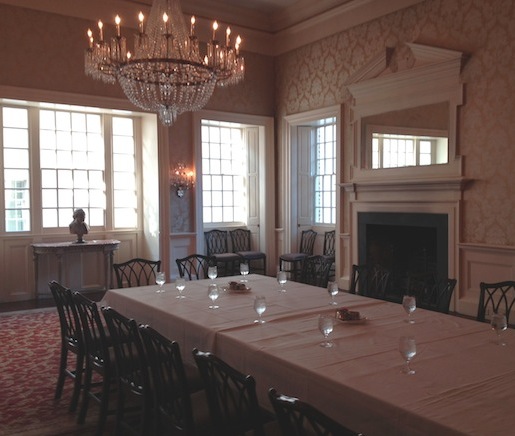
The JBF Food Conference season kicked off last week with our first regional “salon” held in Charleston, South Carolina, at the beautiful and historic McCrady’s Restaurant. Conceived as a way to engage food system stakeholders from around the country and to gather input on the themes for our annual conference, our salons spark fascinating discussions on the critical topics we face. The theme of this year’s conference (click here to learn more) is: A Crisis in Confidence: Creating a Better, More Sustainable Food World We Can Trust.
Facilitated by JBF executive vice president Mitchell Davis and food system consultant Karen Karp of Karp Resources, a diverse group of 18 insightful chefs, farmers, restaurateurs, educators, and other members of the Charleston food community shared their opinions on what’s happening in today’s food system (see below for details about the participants).
Whenever we talk about our food system, an underlying theme of trust inevitably pops up. How is trust in the food community formed? Where do we place our trust—in local producers, large corporations, government regulation, or scientific research? How do we maintain these levels of trust? How can we work together to improve it? Our salon participants were asked to consider trust through a variety of lenses, one of which was the concept of place—how geography, regional identity, and community play into the notion trust in our food system.
The discussions were riveting, and we’ll be posting about all of the concepts in the coming days. First up, here’s what our salon participants had to say about the context of place as it relates to trust in our food system:
Everyone felt that Charleston was a great case study because of its cultural identity and the symbiotic relationships between local farmers and chefs. One farmer said, “Restaurants in Charleston are very engaged with the farmers; it’s a constant dialogue between the back and front of the house.” Meanwhile, a chef explained, “The defining element of Charleston food right now is being at the right place at the right time. The vibrancy of the city drives us; we’re able to make mistakes and keep moving forward.” And another farmer stated, “We have a distinct focus on heritage here; you don’t hear people lamenting the loss of their cuisine elsewhere in country. You don’t see the conversation as part of the public ethos in other places. We’re not just growing heirlooms; our local cuisine is based on our heritage.”
In addition, the notion of place had a lot of resonance in the context of community action. A local business owner said, “To inspire real change, maybe a more natural progression is to work on a smaller scale: let’s look at our own state. We need to do the best things we can do as a community, and then say, ‘Watch this! Here’s how we’re going to feed our people in a responsible and socially equitable way.”’ A nonprofit organizer agreed, and emphasized the important of education: “If you’re going to talk about making a difference on a local level, the germ of it is education. And children are our future consumers.” Meanwhile, an educator said, “The solutions are going to be local, whether the reasons are political, financial, or anything else. Models are being created within communities.” And finally, the discussion ended with an interesting suggestion: “We need to learn how to quantify pride, since it’s so important to every food culture in the world. And that extends beyond the city limits of Charleston.”
We’ll continue to report on our regional salons as they occur, as well as the other concepts discussed in Charleston, so stay tuned!
Our upcoming JBF Food Conference and Leadership Awards will take place on October 17 and 18, 2012 at the Hearst Tower in New York City. To receive updates and registration information, please send us a note at: foodconference@jamesbeard.org.
Our Charleston salon participants were:
JBF Award Winner Sean Brock, Husk and McCrady’s; JBF Award Winner Mike Lata, FIG; JBF Award Nominee Craig Deihl, Cypress; Maria Baldwin, Thornhill Farm/Our Local Foods; Susan Bass, Slow Food Charleston; Dave Belanger, Clammer Dave’s Sustainable Gourmet; Sara Clow, GrowFood Carolina; Emile DeFelice, Caw Caw Creek Farm; Jamee Haley, Lowcountry Local First; Allisyn Miller, Slow Food Charleston; Glenn Roberts, Anson Mills; Harry Root, Grassroots Wine; Nikki Seibert, Lowcountry Local First; Marion Sullivan, The Culinary Institute of Charleston; Lisa Turansky, Coastal Conservation League; Jennifer Wassum, Rebellion Farm; Randi Weinstein, BB&T Charleston Wine + Food Festival; and Megan Westmeyer, Sustainable Seafood Initiative at the South Carolina Aquarium.


