A Very Good Apple Pie
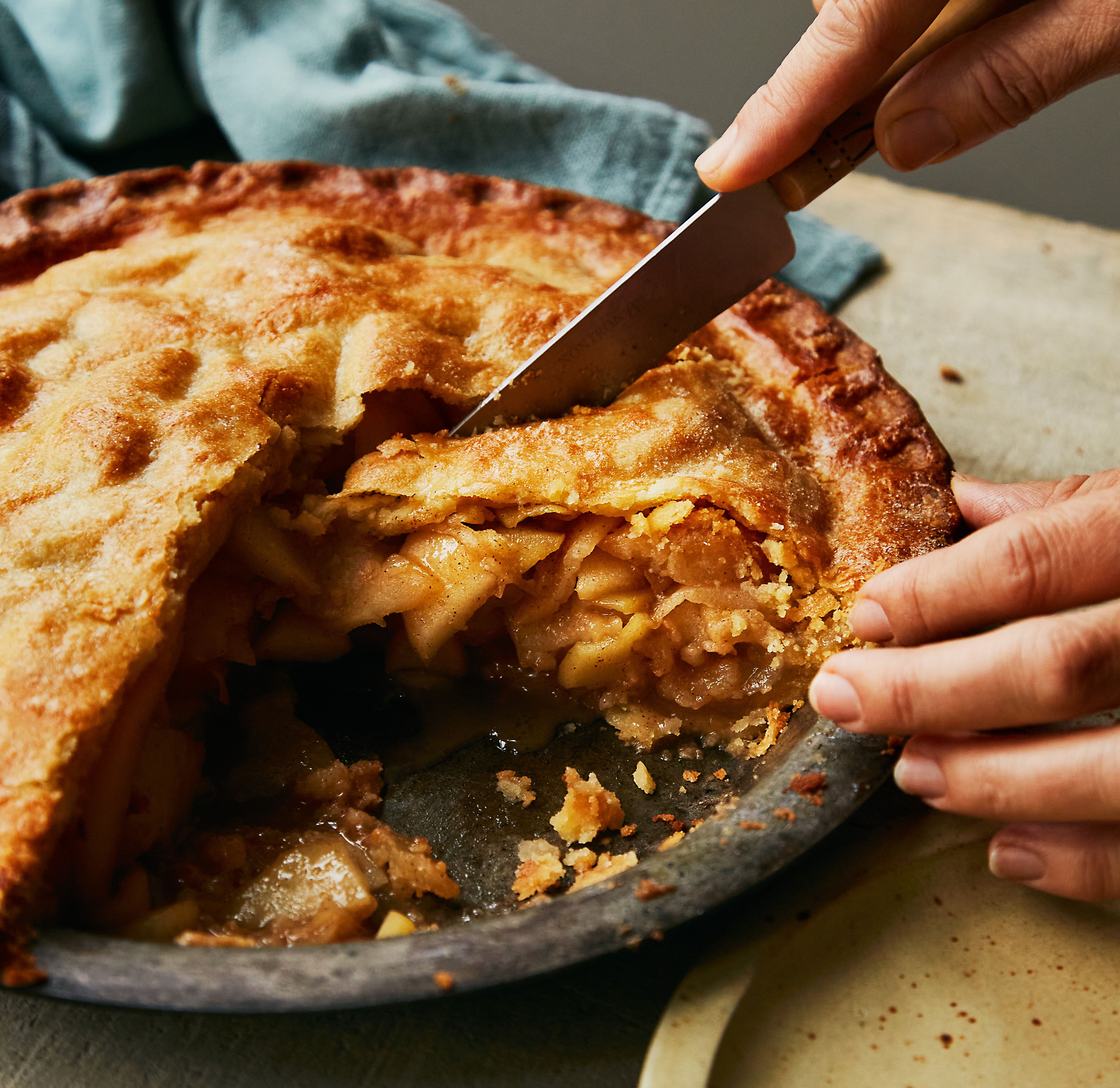
Photo: Laura Edwards
"My friend Caroline, a fellow Melburnian in London, was telling me that her husband, recovering from an illness, was craving an old-fashioned apple pie. He couldn’t stop thinking about the one from Johnny Ripe on the Mornington Peninsula, a region on the bay outside Melbourne.
Well, we were a long way from the Mornington Peninsula (about 12,000 miles!), and I’ve tasted many apple pies, but not the one from Johnny Ripe. Still, there was a person in need, so an apple pie had to be produced. Having nothing to go on but Caroline’s description, I set to work.
I use three different types of apples, not to make life difficult but because each contribute their own flavour and texture: Pink Lady for its crisp, sweet–tart profile, Granny Smith for its firmness and tang, and Golden Delicious for its soft, mellow flesh. Caroline’s husband proclaimed the pie better than Johnny Ripe’s. I don’t know about that, but it really is a very good apple pie!"
—James Beard Award Winner® Helen Goh, Baking and the Meaning of Life
Ingredients
Pastry
- 300 g plain flour, plus extra for dusting
- 90 g icing sugar
- ¼ teaspoon fine sea salt
- 200 g unsalted butter, cold, cut into cubes, plus extra, softened, for greasing
- Grated zest of 1 lemon (about 1 teaspoon)
- 1 large egg yolk
- 20 ml water, ice-cold
Ingredients
Filling
- 10 large apples (ideally 4 Pink Lady, 3 Granny Smith and 3 Golden Delicious), about 2 kg and about 1.3 kg after removing peels and cores
- 100 g caster sugar
- 40 ml lemon juice
- 40 ml apple cider vinegar
- 1 ½ teaspoons ground cinnamon
- ½ teaspoon freshly grated nutmeg
- ¼ teaspoon fine sea salt
- 30 g unsalted butter
- 1 tablespoon tapioca starch or cornflour
Ingredients
Egg wash
- 1 egg, lightly beaten
Ingredients
To finish
- 1 tablespoon demerara sugar
- Ice cream or crème fraîche, to serve
Method
1. Begin by making the pastry. Place the flour, icing sugar and salt in a food processor and pulse a few times to aerate and combine. Add the butter and lemon zest, then pulse until the mixture is the consistency of fresh breadcrumbs. In a separate bowl, lightly whisk together the egg yolk and water, then add this to the mix, pulsing just to combine. Tip the dough out onto a lightly floured work surface and, dusting your hands lightly with flour, pat the dough gently to bring it together. Divide the pastry in two, wrap each half loosely in plastic wrap and press gently to form flattish discs. Chill in the fridge for at least an hour (and up to 3 days) before using.
2. Meanwhile, make the apple filling. Peel and core the apples, then cut into slices no more than 5 mm thick. Add a couple more apples if needed to ensure you have 1.3 kg of sliced fruit. Place the apples, sugar, lemon juice, vinegar, spices and salt into a large bowl and toss to combine. Allow to macerate at room temperature for at least 30 minutes (and up to 2 hours), tossing from time to time. Drain the apples and reserve the juice in a jug or bowl – there should be about 120 ml. If it is short of that amount, add some extra lemon juice or apple cider vinegar to make up the shortfall, then set aside.
3. Now cook the apples. Place a large sauté pan (preferably non-stick) over medium heat and add half the butter and half the drained apples. Cook, tossing regularly, for about 10 minutes, until the apples just begin to soften but do not take on too much colour. If they start to colour too much, lower the heat a little. Tip the cooked apples into a bowl and repeat with the remaining butter and raw apples. When the second batch of apples has softened, return the first batch to the pan. Whisk the tapioca starch or cornflour into the reserved juice and add this to the pan. Cook for about 1 minute, until the juices thicken, then remove from the heat and scrape the apples into a large, wide bowl to cool.
4. While the apples are cooling, prepare the pie case. Grease a metal pie tin about 26–28 cm in diameter with the extra softened butter, then set aside. (I use a Netherton Foundry spun iron dish measuring 28 cm from rim to rim and 21 cm across the base.)
5. Preheat the oven to 190˚C fan-forced and place a heavy baking tray onto the middle shelf to heat up.
6. Remove one of the pastry discs from the fridge. If it has been refrigerated for longer than an hour, allow it to rest at room temperature for a few minutes, then tap the pastry with a rolling pin to soften it slightly. Lightly flour your work surface, then roll the pastry out to a circle about 33 cm in diameter and about 4 mm thick. Flour your rolling pin, roll the pastry up around it, then gently unroll and drape it over the pie tin. Using your thumb, gently press the pastry into the corners of the tin, leaving an overhang all around the edge for sealing and crimping. Place the tin into the fridge to chill while you roll out the second disc of pastry, once again to about 4 mm thick. Slide it onto a baking tray lined with baking paper and set aside somewhere cool, or in the fridge if it is a very warm day.
7. When the apple filling has cooled, spoon it into the pastry-lined pie tin – it should fill the entire base and form a slight dome shape on top. Brush the egg wash all over the pastry rim, then drape the second pastry circle on top. Press the edges of the 2 pastry circles together to seal, then trim the overhang before crimping to form a decorative border. Brush the egg wash all over, then sprinkle with the demerara sugar. Using a small knife, make a few slashes in the pastry top to create vents for steam to escape, then place the pie on the preheated baking tray in the oven. Bake for about an hour until golden brown (if the pie begins to darken too much, cover it loosely with foil). Remove from the oven and rest for at least 30 minutes before serving with ice cream or crème fraîche.
Yield
Serves 6-8