10 Tips on How to Use AI Tools in the Restaurant Business
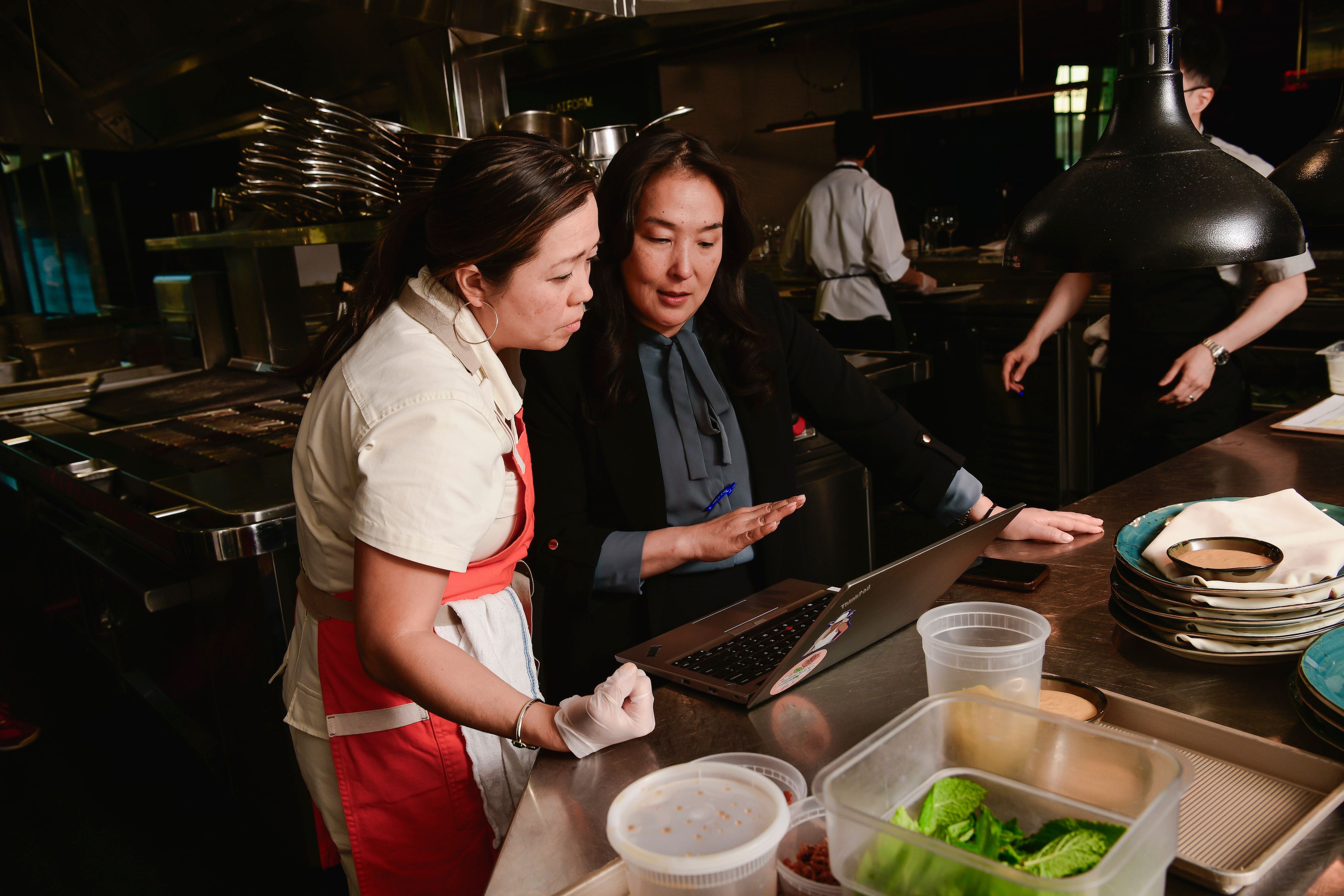
Photo: Max Flatow
Fri, July 10, 2026
Our 2026 Independent Restaurant Industry Report, in collaboration with Deloitte, established that owners and operators are overwhelmed by a technology landscape defined by a constant influx of more tools, more platforms, and more decisions. While widely viewed as essential, operators expressed uncertainty around where to invest as tech systems become more expensive and interconnected.
Our survey data shows that 28% of respondents use only a single technology, while 29% use four or more, underscoring the difficulty of finding the right balance for businesses. While 73% to 83% of restaurant operators who strategically adopt AI report positive business performance, the difference between those thriving and struggling often comes down to how and where this technology gets implemented.
We recently hosted two webinars to provide practical frameworks and insights to help independent restaurant owners, operators, and staff assess where their business stands now and confidently create a course of action for technological optimization.
The pros and cons of using AI at a restaurant
The goal of AI isn’t fewer people—it’s more time for hospitality. Each of our panelists reiterated that AI’s value in restaurants is to ease taxing administrative duties so that chefs can spend more time in the kitchen, and owners and operators can spend more time with their teams and guests. "I don't want [AI] to take the jobs away from my staff,” says Arshiya Farheen, chef/owner of Verzênay in Chicago. “I just want to make it easier for them so they can focus on the people in front of them."
Nevertheless, AI is far from perfect. No platform will satisfy all of a restaurant’s administrative needs, and even well-tailored AI systems can make mistakes. Do not blindly trust AI outputs. AI tends to fill in blanks it does not know—sometimes with big errors. This is especially risky if you are utilizing AI tools for operational areas like finance or legal. It’s smart to cross-reference and verify AI outputs, especially in high-stakes decision-making.
Emma Blecker, founder of Make it Make Sense Consulting, closed her webinar with a reminder of the independent restaurant industry's current moment: As technology absorbs more of the administrative and analytical burden of running a restaurant, the human elements don't become less important—they become the differentiator. "AI is never going to replace the human touch. People crave community and interaction, and restaurants are the heart of that."
Watch the recordings and read on for the top takeaways on how to work smarter with AI, so restaurants can continue to do what they do best: bring people together.

Photo: Max Flatow
10 things you need to know about restaurant tech and AI
1. Audit your current tech stack before buying new
Operators are often paying for systems they do not use all the capabilities of while still seeking out new ones. Before investing, contact your point-of-sale, reservation platform, and marketing tools directly to understand what features they have, including AI capabilities.
2. Tech strategy is data strategy
Restaurants make for a very manual data-entry industry, which means that data is imperfect regardless of the operation. Data hygiene starts with the basics: standardize job titles, inventory structures, and menu items. If you use the title “busser” in one location and “runner” in another, your labor analytics across locations are not comparable.
3. Run pilot programs for new technologies
Start with one location or one team member when adopting a new technology as a change management tool, advises Blecker. You build trust with your team by including them in the process. Once your team trusts that changes make their job easier, resistance ceases and they may begin to request to take part.
4. There is no one-size-fits-all platform
POS systems are owned by credit card processors; inventory management, reservations, HR, and accounting all have deeply specialized needs. Plan your technology stack with the best tools that reflect your segment and growth, connected by integrations.
5. The six must-have foundational systems
Before adopting AI, our panelists agree that independent restaurants should have six foundational systems: point-of-sale, reservations platform, HRIS and payroll, accounting software, inventory management, and labor scheduling. Any AI needs to connect to at least one of these systems, so be sure that your systems are current and accurate first.
6. AI amplifies what already exists
If your data is unorganized, AI will produce misleading outputs, and in turn, ineffective suggestions. If your business has broken workflows, AI can accelerate this—it is not an automatic fix. Before adopting AI, your first question should be “Do I have a strong foundation for this tool to operate?”
7. Build a “master brief” to train AI to think like you
Create a business profile document that captures who you are: your culinary philosophy, sourcing standards, mission and values, target audience, business constraints, goals, and vision. Use your AI tool to organize it into project folders, such as SOPs, marketing, or financial planning. Now, each time you open a conversation with your AI platform, the brief ensures curated and personalized answers right for your business.
8. Turn payroll and sales reports into a weekly financial system
Instead of reviewing reports line by line, upload weekly payroll summaries with clear instructions to check against your defined benchmarks, flagging abnormalities immediately. Reid Schilling, chef/owner of Cowbell Seafood & Oyster in Washington, D.C., performs this task weekly with a checklist of specific items to verify. Add your tip model and other business-specific benchmarks to catch errors before it hits your bottom line.
9. Use AI for menu engineering and cost intelligence
Upload your sales data and menu, and ask AI to produce patterns, drivers of food costs, popular items that may be margin-negative, or new pricing to hit a food cost percentage. Uncover why certain items are not selling. "It's not going to replace your instincts, but it does give those instincts better data to work with,” says Stephanie Perrone-Goldstein, principal and thought leader in Deloitte's Travel and Hospitality practice with a focus on tech, AI, and data strategy.
10. AI can make a valuable brainstorming partner
Not every independent owner/operator has a board or advisor to assist in major business decisions like lease negotiations and pricing, so an AI agent can make a good brainstorming partner. Enter the situation, share the other party’s position, and see what the risks are; not for a definitive answer, but to present questions you may not have thought about. “I'm currently going through a lease negotiation and [AI] is a partner for me,” says Schilling. “I can compare the pitfalls it sees with the pitfalls I think I see. That can wind up saving you big time in the long term."
Rewatch our webinars on restaurant tech and AI
Special thanks to our webinar panelists for their expertise and insights, including Emma Blecker, founder of Make it Make Sense Consulting; Arshiya Farheen, chef/founder of Verzênay in Chicago; Reid Schilling, chef/owner of Cowbell Seafood & Oyster in Washington, D.C.; and Stephanie Perrone-Goldstein, principal and thought leader in Deloitte's Travel and Hospitality practice with a focus on tech, AI, and data strategy.