Dining by Design: Exploring an Often Unsung Ingredient in a Memorable Meal
Brooke Hodge and Dung Ngo
Brooke Hodge and Dung NgoMarch 04, 2013
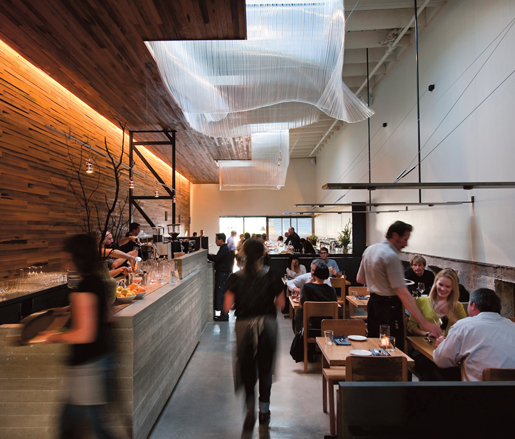
Edison lightbulbs. Communal tables. Open kitchens. Restaurant design trends come and go, but in the 15 years since the James Beard Foundation began recognizing outstanding restaurant design, ambience has become an essential element of the dining experience.
Reflect upon your favorite meal of the past year: whether it involved impeccable flatware, plush upholstery, perfectly balanced acoustics, or regional authenticity, the design and overall ambience are likely to have played a starring, albeit subtle, role in the memory.
The heightened role of design within restaurant culture has grown out of ever savvier diners, a growing awareness of design in everyday life, and food blogs that splash photos of restaurant interiors before the first dish is even plated, setting new standards for the overall dining experience. These days, design can make or break a restaurant.
An Immersive Event
To create a memorable dining experience, the physical environment is in some ways as important as the food that’s being served. A good design will present a seamless aesthetic from the linens, the cutlery, and the lighting to the website, menu graphics, and even the noise levels.
“Like food, design is about the experience of pleasure,” says Andre Kikoski, 2010 JBF Design Award winner for the Wright in New York City. “The shape of a room and the weight of a fork, the sparkle of light, and the comfort of a chair all work in harmony, just as do the flavors and textures of great food.”
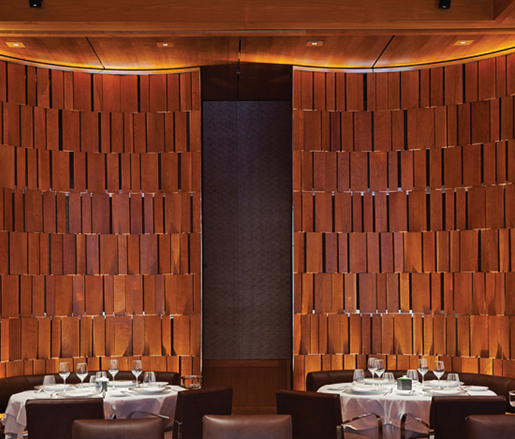
Paul Bentel—whose firm, Bentel and Bentel, won an award in 2012 for the redesign of the legendary Le Bernardin—believes there are three essential components to the dining experience: food, service, and design. “If any of those are insufficient or out of tune with the other, the delicate balance between them is upset and the promise of something special cascades into the realm of the ordinary.”
According to Kristina O’Neal, a partner in AvroKo, which won awards in 2004 for both the design and graphics of New York City’s Public, the experience of design is an important part of the whole. “People want to enter an immersion of sorts,” she explains. “All elements of a restaurant should be supporting one another to complete that immersive event.”
Opportunities from Challenges
Just as the sluggish economy of the past few years has affected the food industry, it has also had a profound but surprising impact on design. “The downturn has created both the opportunity and the need to be more reflective about what is important in the design of restaurant interiors,” says Bentel. “There is less urgency to create something out of the ordinary and greater focus on achieving an authentic, straightforward, high-quality result.”
For Pam Dorr, of the Hale Empowerment and Revitalization Organization (HERO)—a housing-advocacy nonprofit that collaborated with the design collective Project M on PieLab in Greensboro, Alabama, a finalist for design in 2010—financial limitations have generated creativity. “Using free and found materials encourages innovative, hyper-local design whose ingenuity leads to new opportunities for both the diner and the designer,” she says. PieLab, whose spare, simple interior design makes use of repurposed materials from the neighborhood, also has a socially conscious mission and a strong connection to its community.
The result is a win-win for diners. “Restaurants are becoming increasingly specialized and tailored in the environments they offer, yet are doing so in a way that emphasizes simplicity, comfort, and modesty,” says Kikoski, “This is not necessarily a bad thing,” he adds, explaining that paring a restaurant down to its essence can create a strong, unique, and memorable environment for patrons.”
A Sense of Place
Visual appeal is the foundation of successful restaurant design, but a design that reflects its location can exponentially enhance the dining experience. Kikoski’s interiors at the Wright, which is located inside the Guggenheim Museum, are a perfect example. He incorporated commissioned artwork and carefully considered and respected Frank Lloyd Wright’s own architecture in his design. The resulting space is vibrant and airy—a change from the usual dark, crowded, cafeteria-like museum restaurant.
Modern restaurateurs also ask architects to evoke the unique locale and flavors of a dining establishment in their designs. “We are currently working on restaurants in Boston, Las Vegas, Aspen, Colorado, and New York City,” says Bentel. “That regional diversity informs our work and broadens our thinking about the best in hospitality design.”
When Joshua Aidlin and David Darling designed San Francisco’s Bar Agricole, they worked closely with the restaurateurs to craft a space that would reflect the cuisine, but they also considered the restaurant’s surroundings and how the space would be used. The venue, located between San Francisco’s new media gulch and the older Mission district, is a bar/restaurant hybrid, where food, cocktails, and ambience all add up to a unique communal experience.
“There are so many things that make a great restaurant and they’re almost always about food,” say Aidlin and Darling. “That said, physical comfort, the experience, and community are a vital part of the equation.”
Building Communities
Aidlin and Darling are not alone; many restaurant designers also strive to foster community—among diners, cooks, farmers, and other purveyors—to promote something larger than a dining establishment in the traditional sense.
Los Angeles–based Bestor Architecture, a Design Award finalist for Culver City, California’s Pitfire Pizza, is just one firm focusing on community. Having designed some of the most talked-about dining spaces in and around Los Angeles, architect Barbara Bestor is taking the lessons learned from her restaurant work and applying them to other kinds of projects, such as cafes and large corporations, who, she explains, “want innovative eating zones in their office spaces to encourage workers to eat together, share stories, and collaborate.
This interest in building community is not restricted to the two coasts. PieLab in Alabama has become a destination for both locals and out-of-towners, who come for a slice of hot pie and local culture. “It is novel in our rural area to have such a welcoming space where creativity and good food come together to celebrate community,” says Dorr, who also acts as general manager and host of this remarkable enterprise.
A blue flag hanging prominently at PieLab underscores Dorr’s point with the following motto: “Pie & Conversation, Optimism & Design.” “When design can reflect a community,” she says, “the ability to celebrate good food in the space makes for a positive and participatory experience for all.”
Brooke Hodge and Dung Ngo are members of the James Beard Foundation Design Awards Committee. Additional reporting by Alison Tozzi Liu.


