Where I grew up there were two seasons: frozen-custard season and no-frozen-custard season. Maine summers were all about our semi-weekly trips to Hodgman’s, which is open for business only from Mother’s Day to Labor Day. Sitting in the back of my parents’ Subaru, I knew we were halfway there when we passed the peeling wooden church.
Fast-forward to last summer, when I visited Hodgman’s for the first time in years, this time accompanied by friends and fellow New Yorkers. Not much had changed. The stand still bears a sagging awning that shelters dogged customers on rainy evenings. The menu is the same, too. It features parlor standards with sprinklings of Northern parlance (jimmies) and regional specialties (like the “tin roof.”)
My expectant friends plied me with questions: What’s the best flavor? How are the sugar cones? What the heck is a tin roof? (A sundae topped with chocolate syrup and peanuts.) Oh, and what is frozen custard, anyway?
Oddly enough, the last question stumped me. I knew frozen custard was delicious and dense, like a thicker, more resilient ice cream. I knew it wasn’t gelato and it wasn’t soft-serve, but I wasn’t sure what it was.
I hadn’t had much luck finding what I considered to be frozen custard elsewhere. In attempts to track it down in my adult life, the occasional soaring hope had always been struck down by soft-serve shams. Whatever they scoop at a popular New York chain known for its frozen custard has good flavor, but the texture is all wrong. It should be thick enough to keep a staked spoon standing at attention.
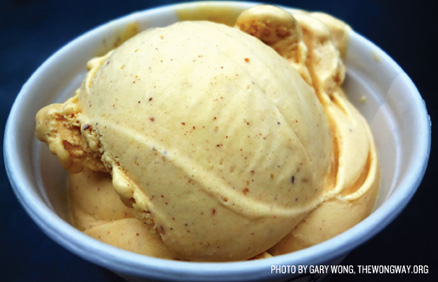
Standing in line at Hodgmans, I thought about my favorites: a sugar cone holding a single globe of vanilla custard encrusted with chocolate jimmies or coated with the chocolate syrup that eventually—if you can stand to wait—hardens like a shell that you puncture with your spoon. A plain clean scoop, its smooth mouthfeel unimpeded by toppings, also tempts.
While frozen custard was actually born on the Coney Island boardwalk in 1919, it really took off at the 1933 World’s Fair in Chicago, eventually making its way across state lines and into Wisconsin. Milwaukee is now the unofficial frozen-custard capital of the world, playing host to an intense three-way rivalry among Leon’s, Kopp’s, and Gilles.
If you happen to stumble upon the rare frozen custard stand outside of the Midwest, chances are its owners can be traced back to the Badger State. A 1990 article from my hometown’s newspaper revealed that my childhood stand was opened in 1946 by Hyacinth Hodgman, a Milwaukee native.
By law, frozen custard must contain at least 10 percent butterfat and 1.4 percent egg yolks. That yolk stipulation may sound miniuscule, but it is crucial in achieving a satiny, emulsified product. (Most conventional ice cream contains far less egg; Philadelphia-style ice cream has none at all.)
But frozen custard’s most vital ingredient is air—or, rather, a lack of it. Commercial ice cream producers briskly whip gulps of air into their product, ballooning its volume and ensuring that hundreds of gallon-size cartons get packed to the brim. This expansion is called “overrun,” and some ice creams are bloated with air by as much as 100 percent. This means your container of Häagen-Dazs may be packed with just as much oxygen and nitrogen as with, well, ice cream.
Frozen-custard producers strive to keep overrun low, paying handsomely for stately, gleaming machines that churn and extrude large batches at an unhurried pace. Mixing up frozen custard is expensive and time-consuming, and custard stands are traditionally limited to making only vanilla, chocolate, and a daily “special flavor.” But that extra cost and effort means your dollars are paying for nothing but pure frozen custard.
Unfortunately for me, it also means that businesses making the real McCoy are few and far between, and that’s why I was savoring this visit to Hodgman’s. Suddenly, the window opened and I had to decide.
At Hodgman’s with my frozen custard virgin friends, I went with my gut and asked for a dish of vanilla custard coated in chocolate sauce. The exchange of ordering still had a secretive, formal way about it: the window remains shut except during a hand-off of custard or change, never needlessly open. Next thing I knew an outstretched arm presented my treat. I took it, went back to our car, and waited for the shell to harden. Then I broke through for a bite.
Authentic frozen custard is an artisanal product that requires time and care. To find out if there’s a frozen-custard stand near you, visit custardlist.com.
This article originally appeared in the August/September 2010 issue of JBF Notes, the James Beard Foundation member newsletter. Don't miss out on future articles; become a member today!


